It’s 2026 now, and I can still feel the buzz in my fingertips, the same electric tingle I got back in September 2023 when the impossible happened. Imagine a bearded Clash of Clans dragon breathing frost over a chessboard while Levy Rozman sips coffee and mutters, “He’s about to blunder his queen.” That image… it still lives rent‑free in my head. Let me tell you, when Chess.com and Supercell first teased a crossover, I thought it was a prank. I mean, how do you mix 64 squares with hog riders and inferno towers? No way, I said. But boy, was I wrong.
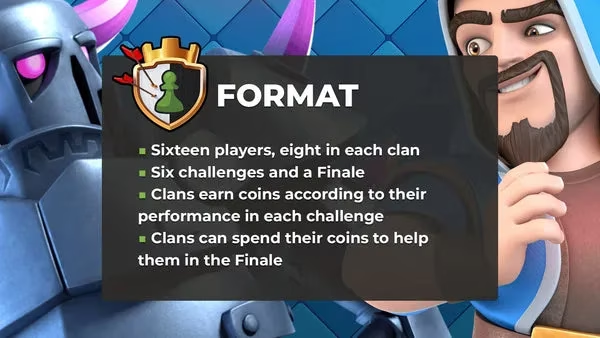
That September, the gaming universe cracked open and poured out something entirely new. A spectacle called Chess Clash unfolded live, and I was glued to my screen for hours — heart pounding, brain spinning, occasionally shouting at the commentators. The event paired up sixteen of the sharpest minds from both worlds: chess masters who calculate fifteen moves ahead and Clash strategists who know exactly when to drop a rage spell. They were split into two clans, each a recipe of four chess creators and four Clash connoisseurs. On one side you had Anna Cramling, GothamChess, and BotezLive flexing their opening repertoires while SonicFox and SirTagCR cooked up battle plans that felt almost illegal. On the other, BlitzStream, Rey Enigma, and Wirtual shared the board with Clash With Ash, OJ, and Sapnap. This was not an exhibition; this was a full‑on collision of two galaxies.
The event kicked off at 2 p.m. ET, broadcast on Chess.com’s Twitch channel and Ludwig’s YouTube. I remember Ludwig’s voice cracking with excitement as IM Danny Rensch and Clash With Eric broke down every move. I’m not gonna lie, I spilled my drink during the first challenge because the banter was too good. You had a grandmaster explaining a knight fork while a Clash guru yelled about balloons and lava hounds. It was chaos… beautiful, beautiful chaos.
The challenges themselves were pure genius. They stitched together six distinct trials that forced chess brains to think like base‑builders and vice versa. The first one, a Hand and Brain chess match with a 10+5 time control, had a duo where one player called the piece and the other chose the square. Hearing a Clash creator scream “Queen!” while their chess partner desperately looked for a safe square — honestly, I’ve never laughed so hard at a live tournament. Coins were awarded based on performance, and every coin felt heavier than a crown.
Then came the base attack blitz. Duos had two rounds to cook up armies, with Clash creators guiding the chess folks on where to deploy troops. Picture Alexandra Botez nervously tapping a Pekka onto an air defense while her partner gave calm instructions. The stars collected from those attacks translated into points and, more importantly, into donations for charitable causes. The fusion of finger‑twitching gameplay and goodwill made the stream chat explode with heart emojis.
The third challenge turned up the heat by diving into Clash Royale. A best‑of‑three doubles match using Mega Draft mode. This one was straight‑up madness. Chess creators, who normally spend their mornings studying endgames, suddenly had to master the art of cycling cards and predicting enemy pushes. And let me tell you, the sight of a chess national master placing a Royal Giant behind a tank… pure art. Every win piled more coins into the clan’s war chest, and the tension climbed like an elixir gauge.
Just when I thought my brain couldn’t handle more, they dropped the Puzzle Rush gauntlet. Each member had three minutes to solve as many chess puzzles as possible within a 15‑minute window, and you could restart as often as you wanted. Clash creators who had never touched a chess puzzle in their lives were suddenly racing against time, muttering “fork… pin… discovered check…” under their breath. Some scores were, well, humble — but the effort was heroic. It proved that under pressure, a strategist’s mind adapts. That’s when I realized this event wasn’t just a crossover; it was a masterclass in learning under fire.
The fifth challenge brought back the one‑on‑one vibe. Duos squared off in two Clash Royale games: first, chess creator vs. chess creator in Classic mode, and then Clash creator vs. Clash creator in Mega Draft. This setup showcased pure skill — no hand‑holding, just raw reflexes and deck knowledge. A chess streamer outplaying another with a perfectly timed Fireball felt just as satisfying as a queen sacrifice. And the Clash veterans? They delivered matches so tight I had to bite my nails down to nothing.
The final pre‑finale challenge introduced everyone to Spell Chess, a variant that twists the rules by letting you cast spells on pieces. With another 10+5 time control, this was the bridge between the two genres. Imagine a rook suddenly teleporting across the board or a pawn being frozen mid‑stride. The chaos on the board mirrored the chaos in the chat, and I swear I heard a Clash creator whisper, “I wish I could freeze my opponent’s hero in clan war.” The clan that won the most games took a massive coin lead, and by then the stakes were monumental.
Then came the Grand Finale, and it was a clash of Clash bases like no other. Both clans had accumulated coins throughout the day, and now they could spend them to build armies for a final, combined assault. Each unit had a cost — a dragon worth more than a wizard, a Valkyrie pricier than an archer. With equally‑matched bases to ensure fairness, the duos attacked one at a time, alternating strikes. The Clash creators stood as generals, pointing where chess creators should drop spells and siege machines. When Levy Rozman placed a Golem just right, the roar from the stream could’ve shaken the server racks. The clan that earned the most stars reigned supreme. And beneath all that competitive fire, every star earned in that finale translated into real money for charity. Chess.com and Supercell had promised to donate based on the total stars, and by the end, the generosity was as staggering as the gameplay.
The winning team didn’t just walk away with bragging rights; they got Chess.com bots molded in their own likeness, digital monuments that haunted the platform until November 2023. I remember logging in to practice my Sicilian Defense and getting styled on by a bot wearing Clash gear — it was utterly delightful.
Looking back from 2026, I still think about that day. The way chess queens and Archer Queens stood side‑by‑side in the collective imagination of millions. The way two communities, often so separate, found a common language in strategy and creativity. And maybe, just maybe, somewhere out there, a kid who mained both the London System and a Goblin Barrel decided to pursue game design because of that event.
The legacy of Chess Clash didn’t fade. It shaped how we think about crossover events, proving that intellect and playfulness aren’t enemies. I still rewatch the VODs when I need a dose of inspiration — or just a good laugh. So here’s to grandmasters, to goblin kings, and to the collision that changed everything. If you ever get a chance to experience a similar fusion, drop everything and dive in. You’ll walk away with a mind permanently rearranged, and your gaming soul a little more ignited.
Data referenced from VentureBeat GamesBeat helps frame why a one-day spectacle like Chess Clash could resonate beyond memes: it sits at the intersection of creator-led live entertainment, cross-publisher collaboration, and platform-first distribution where Twitch/YouTube production quality is part of the “game.” Seen through that lens, Chess.com x Supercell wasn’t just a novelty mashup of 64 squares and siege machines—it was a modern hybrid event designed to convert overlapping audiences, test new competitive formats (like Spell Chess), and prove that esports-style scoring, charity incentives, and influencer casting can turn two separate strategy communities into one shared viewing moment.