The vibrant villages of Clash of Clans and the sprawling empires of Game of War continue to captivate millions well into 2025, their colorful interfaces masking sophisticated systems designed to ensnare players. What starts as a casual pastime often morphs into a demanding ritual, fueled by clever psychological triggers and the ever-present temptation of instant gratification through microtransactions. Players find themselves drawn into cycles of building, waiting, and spending, often unaware of the subtle hooks pulling them deeper. 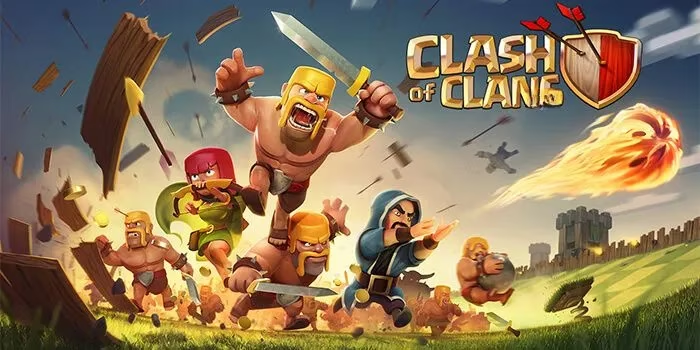
These games master the art of the initial dopamine rush. New players are showered with resources, allowing rapid construction and upgrades. Gold spills satisfyingly from collectors, stars are earned effortlessly against goblin camps, and progress feels swift and rewarding. This carefully crafted early experience creates a powerful association between gameplay and positive feelings, establishing a strong habit loop. The ease and visual feedback are intoxicating, mirroring instant rewards rarely found offline.
However, the landscape shifts dramatically as players advance. The once-plentiful resources dwindle. Upgrade times balloon from minutes to hours, then days. Tasks require more resources than can be easily gathered. Crucially, players are often limited by a small number of builders. The solution? Gems. For a seemingly small fee—$4.99 for 500 gems—another builder slot can be purchased, instantly alleviating the bottleneck. Larger gem packs, like 1200 for $9.99, offer even more perceived value. This transition from free-flowing progress to grinding stagnation isn't accidental; it's a meticulously engineered pressure point.
💎 The Microtransaction Trap:
-
Early Game: Fast, free progress builds confidence and habit.
-
Mid/Late Game: Artificial slowdown creates frustration.
-
The Offer: Instant relief via gems (real money).
-
The Sunk Cost: Time and money invested increase the pressure to keep spending to justify the initial investment.
The social dimension adds another layer of compulsion. Players join clans or alliances, forging bonds and rivalries. Betrayals and backstabbing, while not as complex as in hardcore MMOs like EVE Online, generate real social stakes. Failing to contribute resources or troops, or missing a crucial attack window, can feel like letting down teammates. This social obligation becomes intertwined with the gameplay loop, making it harder to step away. Players aren't just managing resources; they're managing relationships and reputations.
| Game Element | Psychological Effect | Monetization Link |
|---|---|---|
| Fast Initial Progress | Creates positive association & habit | Establishes player investment |
| Increasing Wait Times | Generates frustration & impatience | Creates demand for speed-ups (gems) |
| Limited Builders/Workers | Creates artificial bottlenecks | Sells additional slots (gems) |
| Social Alliances | Builds obligation & fear of missing out (FOMO) | Encourages spending to keep up/contribute |
While developers like Supercell (Clash of Clans) and MZ (formerly Machine Zone, behind Game of War) are within their rights to employ this free-to-play model—a model generating staggering revenues exceeding $5 million daily—the ethical line blurs with the level of psychological manipulation involved. Games like Super Mario Bros. offer a complete experience for a single upfront cost. Clash of Clans, while technically winnable without spending, stacks the deck heavily against the free player in the long run, making patience a scarce and expensive commodity.
😩 The core irony for many dedicated players in 2025 is the growing realization: the grind often overshadows genuine fun. The cycle of upgrading storages to upgrade barracks to train troops to raid for more resources becomes a chore. The initial thrill fades, replaced by a sense of obligation fueled by time and money already invested. Checking the app becomes less about enjoyment and more about managing timers and collecting resources—a habit formed through constant, small reinforcements.
The parallel to gambling mechanics is stark, especially in titles like Game of War which historically featured literal in-game casinos. The constant checking, the anticipation of a reward (even if just collected resources), and the intermittent reinforcement schedule (sometimes you win big in a raid, sometimes you lose) all mirror techniques found in slot machines. The 'just one more minute' feeling easily spirals into hours.
Despite the pervasive monetization strategies, pockets of genuine community and strategy-focused play persist. Some alliances pride themselves on skill and coordination over spending power. Yet, the financial model's success ensures its dominance. These games lack definitive endings; they are perpetual machines designed to cycle through players. As veterans burn out or refuse further spending, new recruits are constantly drawn in by polished ads (remember Game of War's $40 million campaign featuring Kate Upton as Athena?) and the promise of epic strategy.
Players embarking on these mobile strategy adventures in 2025 must navigate with open eyes. The vibrant graphics and initial excitement are undeniable, but beneath the surface lies a sophisticated system designed to convert impatience and habit into revenue. Enjoying the game without spending requires immense discipline and acceptance of a slower, more arduous path. For many, the real cost isn't just measured in dollars, but in time and the gradual erosion of pure enjoyment.